Climate Action
The Time We Cast Our First Vote
September 16, 2025
In the United States, it seems that many of us are taking every citizen’s right to vote in political elections for granted. In the 2024 presidential election, about 36% of eligible voters did not cast their ballots and in local and congressional midterm elections, the number of voters that show up to the polls in the U.S. biggest cities for example is often much lower.
Perhaps we have forgotten that for many of us, the right to vote had to be fought for. Just over 200 years ago, mainly only white Christian men with property could vote in most states. By the 1820s–1850s, property requirements were abolished, but voting was still largely limited to white men. The road to universal voting rights was long and slow.
In 1870, the 15th Amendment barred voting right discrimination on the basis of race, allowing Black male citizens the constitutional right to vote, although it allowed individual states to determine the specific qualifications needed for suffrage. This meant that in reality many barriers such as literacy tests, poll taxes, grandfather clauses, violence, and intimidation, kept Black men away from the polls in the South for example.
It wasn’t until 1920, that the 19th Amendment granted women the right to vote, though in practice many women of color still faced local and state restrictions. In 1924, the Indian Citizenship Act recognized Native Americans as U.S. citizens, imbuing them with voting rights, though some states continued to block them from voting for decades.
In 1952, the McCarran-Walter Act allowed all Asian immigrants to become citizens and therefore vote. The 26th Amendment in 1971, lowered the voting age from 21 to 18, extending the right to millions of younger Americans.
At EARTHDAY.ORG, we know how the power of voting has never been more important. This National Voter Registration Day, we wanted to share how the experience of voting for the first time impacted some of our staff.
Evan Raskin, National Campaign Manager, EDO
“My first time voting was as a freshman at American University, where I cast my ballot in the 2016 election by mail. For students like me, voting by mail was truly a lifeline; it allowed us to participate in democracy even while we’re away from home, and it ensured that I could make my voice heard at a formative moment in my life. For me, filling out that ballot was more than just paperwork; it was my first real chance to influence society by formally engaging in civics. It gave me a sense of empowerment, a new opportunity to do something meaningful about the issues I cared deeply about. Growing up in Massachusetts, we learned that our revolutionary roots were defined by the public fighting for democracy and self determination by any means necessary. Casting my first ballot by mail allowed me to not only have a voice in national decisionmaking, but also gave me a voice in the community that had taught me so much about the importance of civic responsibility.
On Election Day itself, my friends and I walked through my Washington D.C. neighborhood, and felt the energy and excitement from people of all ages who were eager to take part in shaping the future. As we passed a local polling location housed in a church, we heard an elderly election worker call out to us. “Go get ’em boys!” he cheered with a tip of his hat. He may not have known that our ballots were already cast, but his sentiment still rang true. Democracy flourishes when we all support each other to have a voice. This is what it means to complete one’s civic duty.”
Dennis Nolasco, Education Coordinator, EDO
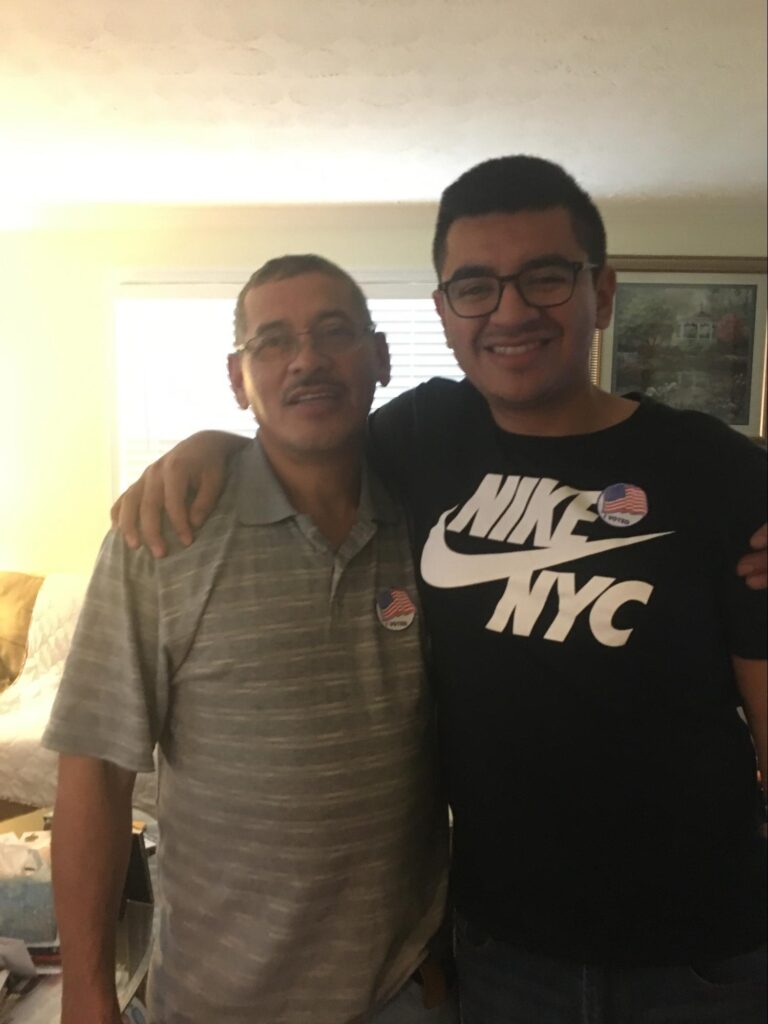
“I still remember the first time I voted. Back in 2010, during my senior year of high school, my government teacher made us study and take the U.S. citizenship exam as part of the class. At the same time, my dad was studying for his own U.S. citizenship test. We spent hours together at the kitchen table going over questions, quizzing each other, and stressing over whether we’d both pass; me for my grade, him for his future American citizenship.
Thankfully, we both succeeded! I passed my class, and not long after, my dad passed the real thing. By 2012, we were both eligible to vote in a presidential election for the very first time. On Election Day, on a cold November morning, we woke up early and walked together to the local elementary school polling place; the very same school I had attended as a child. I had memories of my parents dropping me to go to school here and now we were going to reach another milestone together. I remember how excited we were: getting our voting plan together, standing in line with our neighbors, sipping the coffee from the thermos my mom had provided. When I cast my ballot and got my “I Voted” sticker, I felt proud. That pride multiplied when I looked over and saw my dad wearing his.
For me, voting was something I had the privilege of being born into. For my dad, it was something he had to earn through years of hard work, determination, and resilience. Sharing that first voting experience with him made me realize just how meaningful the right to vote really is.”
Terran Fielder, Media Specialist, EDO
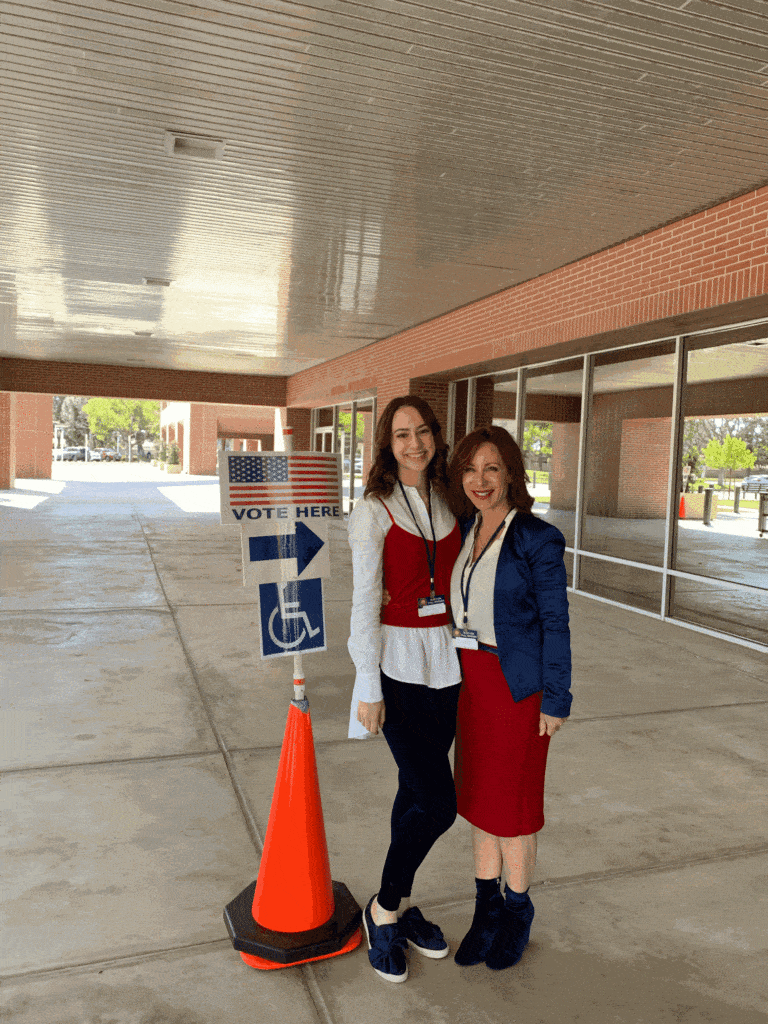
“From a young age, I was involved in the voting process, even before I was eligible to cast a ballot. In my last two years of high school, I would aid other students in registering to vote. And they allow minors to work at the polls, so from the time I was 16 I was joining my mom in helping community members to cast their vote.
The first time I got to vote myself was in the 2020 election. I was chomping at the bit to use my voice. Unfortunately, this ended up being super anticlimactic, because if you remember by November of 2020, most of us were locked up due to Covid. The action I had been waiting for ended up boiling down to dropping my mai- in vote into the mail box. Nevertheless, I put a lot of time, thought, and effort into the process. I researched every candidate, the policies they supported and those they were against.
My parents are the ones who bestowed upon me the sense that voting was a responsibility and a privilege – a civic duty no less, and every night leading up to the election, our dinner table conversation was filled with discussion and friendly debate over who were the best choices for the offices. It wasn’t until I received my “I Voted” sticker in the mail that I realized my opinion had been counted, and an overwhelming sense of pride drifted over me.”
Lee Franklin, Volunteer Coordinator
“Just a little over two months after I turned 18, I voted for the very first time in the Town Council and Mayoral elections of Chapel Hill in November of 2015.
This election was special to me, not only because it was my first, but because the mayoral candidate who eventually won actually hailed from my neighborhood. She also had run for County Commissioner several years before, in an election which my father had also run in. So, I was familiar with the candidates and because of my dad, had a special interest in local politics. My best friend and I had even been attending town council meetings together for fun in the preceding months. We started doing it for a Boy Scout merit badge, but we thought it was interesting, so we kept going afterwards.
One of the most important issues under consideration was the construction of new developments right next to my neighborhood. The election was at the crossroads of so many difficult issues: how to manage population growth in a small community, how to preserve and expand affordable housing, and how to prevent increased runoff that could lead to flooding of neighborhoods downstream.
In high school my friends and I spent so much time wandering the swampy creeks and forests behind my neighborhood. I had waded through miles of creeks, slogged through marshes, encountered A LOT of trash, and seen the water levels rise during rainstorms. So I was very interested in preventing increased runoff caused by development. And in the long run, I wanted to daylight a portion of a creek that ran below a stripmall at the center of the proposed development, so that I could walk through the bed of the creek uninterrupted from my neighborhood all the way to the lake that fed it a few miles upstream.
I’m happy to say my preferred candidate won and served as mayor for eight years. She brought a necessary perspective to the difficult process of growing a small town that people wanted to move to. And she oversaw that growth in a responsible way. I still hope one day they will daylight the creek under the stripmall. This past June, a tropical depression caused flooding in the shopping center so severe that it lifted cars and put dumpsters through storefronts.”
Sarah Davies, Director Communications & Media, EDO
“I became a US citizen last year and while I was too late to vote in any elections back then I was excited to register. I recently ordered a new driver’s licence and took the opportunity to do just that, register to vote, at the same time. It could not have been easier or more efficient. My new licence and voting card arrived in the same week and it made me feel like I truly am a citizen now. More so than even receiving my U.S passport for some strange reason, I think because it’s not passive, it empowers me to act.
Nothing is more powerful than making your voice heard, no matter what you believe in or who you vote for, it’s just so important to turn up. I don’t believe in the idea that not voting is a ‘statement’ – people fought and died for this privilege and I really believe every single citizen should use this important honor, that only we have, and get out there and vote. If you cannot be bothered to vote you cannot complain about the results afterwards if you don’t like them. And in some of these elections every single vote counts so make the time and do it – VOTE!”
Our Voice, Our Power, Our Vote!
Voting is one of the most powerful tools we have to shape our future, but it’s not the only one. After you cast your first ballot, your voice can continue to drive change in countless ways. One of them is by speaking up for strong climate action.
Right now, the EPA’s authority to regulate climate pollution is under threat. This authority comes from what’s called the Endangerment Finding, a critical tool that has allowed the U.S. to take meaningful steps to curb greenhouse gas emissions for years.
Weakening or eliminating this authority would undo decades of progress. If we want cleaner air and healthier communities, we need strong climate policies and public support to back them up.That’s where you come in. Add your name to our public comment in defense of the EPA’s ability to act on climate.Your voice matters; not just at the ballot box, but every time you speak up for a better future.